
Understanding
Biochemistry and mental health: what researchers are exploring
How the biochemistry of your brain and nerve cells may link to mental health issues: cell defences, inflammation, nutrients and what is unknown.
In short: Biochemistry is the study of the processes that keep living cells working. Researchers are studying how the body's biochemistry changes how well a cell uses reactive oxygen species to cleanse, signal, rehydrate and cool itself, which helps protect cell health and mitochondrial function. We study how these changes relate to mental health issues, and how changes in biochemical function can be measured. This is an active research area and many questions are unanswered. By providing our course we are creating a knowledge base to ask the right questions and to direct effective research.
How might the biochemistry of nerve cells be linked to the presence of mental health issues?
Brain and nerve (neurological) cells are among the most active cells in the body. They need a steady supply of nutrients and oxygen, and they depend on enzymes and minerals to make energy and to protect themselves. Researchers are asking whether problems in these processes may be linked to some mental health issues.
What is biochemistry?
Every cell in your body runs thousands of biochemical reactions each second. These reactions make energy, build proteins, send messages between cells and clear waste. Biochemistry is the study of these reactions in a living body.
Why measure it?
Some of these biochemical processes can be measured in blood or urine by a pathology laboratory. Doctors already use pathology to check things like iron, thyroid and liver function. BBH teaches practitioners what research says about markers that may be relevant to mental health issues.
Areas researchers are exploring
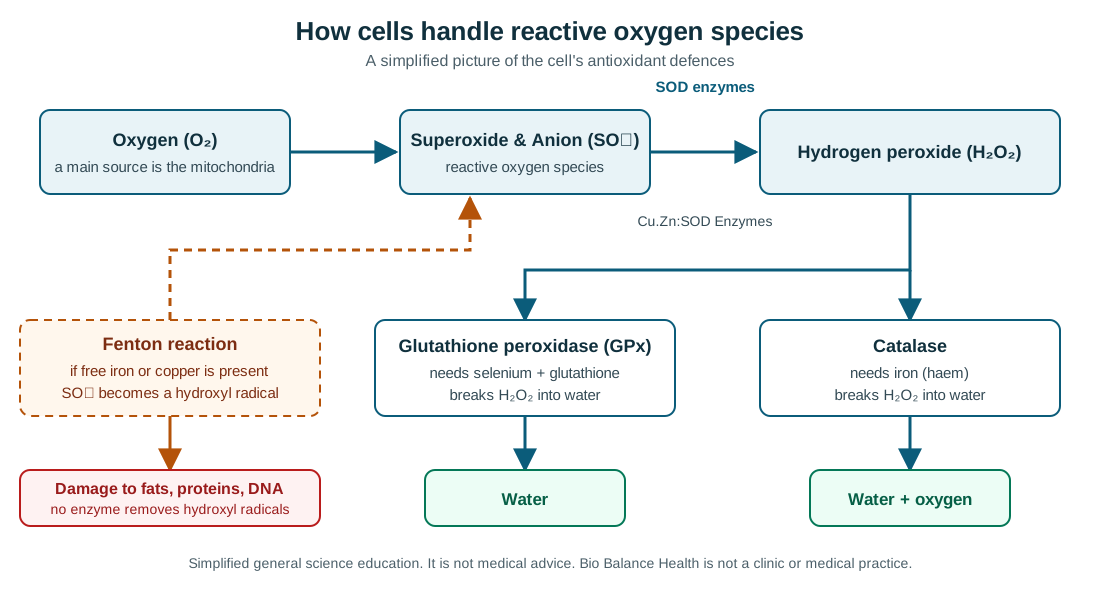
- Reactive oxygen species and the cell's defences. Every cell makes reactive oxygen species (ROS). The general term for when cells face more ROS than their defences can handle is oxidative stress. A controlled amount of "oxidative stress" (the correct level of redox reaction) is essential for cell homeostasis, and without it cells would not function. BBH looks at the specific biochemistry: which ROS, which defence enzymes, and which minerals those enzymes need. Learn more
- Inflammation. The body's response to injury or infection. Markers such as C-reactive protein can be measured. Learn more
- Methylation. A biochemical process that helps control genes and make neurotransmitters, the brain's messengers. It depends on nutrients such as folate and B12. BBH's course focuses on cell homeostasis and does not cover methylation. Learn more
- Nutrients. Vitamins and minerals such as zinc, copper, iron and B6, which many enzymes need. Learn more
- Epigenetics. Biochemical tags that switch genes on and off, and can be influenced by life experience. Learn more
- The gut. Gut bacteria and the brain influence each other. Learn more
Why people differ
Two people can have the same diagnosis and very different biochemistry. Genes, diet, stress, infection, medicines and life experience all play a part. This is one reason research is moving toward more personalised understanding.
What we do not know
- Which markers are reliable enough to guide care.
- Whether changing a marker changes symptoms.
- How findings in small studies apply to everyone.
For each study BBH supports, we say what type of study it was. See Our research.
What to do next
- If you are worried about your health, see your registered doctor.
- Never stop or change medication without your doctor's advice.
- To learn more, try the Glossary.
Bio Balance Health is an education organisation. It is not a clinic or a medical practice and cannot give medical advice. In a crisis, call 000 or your registered medical professional.